Bedeschi Expertise in Ship Unloading Technology
The design of modern dry bulk terminals requires increasingly higher capacities combined with maximum energy efficiency. Achieving this goal is only possible through the optimization of several key aspects, including:
- the selection of equipment that perfectly matches the physical layout of the terminal (both for new developments and terminal upgrades)
- cutting-edge technological and commercial solutions for even the most hard-to-handle materials
- the reduction of OPEX through lower maintenance requirements and reduced demand for spare parts
- the optimization of CAPEX investments
- the meeting of the high-quality standards required by modern port operations.
In light of this, Bedeschi offers tailor-made mechanical Chain Ship Unloaders (CSUs) that combine each one of these key factors, delivering the best solution based on both technical specifications and customer requirements.
As this article will explore, compared to other unloading systems, Mechanical CSUs offer several advantages:
- Significantly higher handling capacities, with rates up to 1,500 t/h
- Improved compliance with environmental regulations, enabling a dust-free unloading process
- Reduced material degradation and breakage during handling operations
- Greater energy efficiency, resulting in lower power consumption
- Reduced maintenance requirements and lower spare parts consumption, helping to minimize OPEX
- Possibility to handle a wide range of commodities, from free-flowing to non-free-flowing materials
MAIN FEATURES OF BEDESCHI MECHANICAL CSUs
To learn more about our CSUs, first let’s take a look at what lies at the heart of the machine and sets it apart from other unloaders. The vertical elevator chain mounts special shaped palettes that are designed to apply friction onto the bulk commodity and create a continuous vertical lifting motion. The product moves like a single mass, with the lower part pushing the above one upwards. Since the chain is enclosed in the boot, the picked-up product forms a continuous column inside the casing, being elevated and then unloaded onto the conveyor. The most effective and widely used solution at this point is the installation of an enclosed conveyor belt as rear conveyor connecting the berth gallery, but Bedeschi can customize the design to better suit the port’s layout or the customer’s needs. In case of non-free-flowing materials to be handled, a cutter can be integrated in the elevator boot. This feature makes the CSU highly versatile, as it is suitable for both non-free-flowing and free-flowing commodities.
MECHANICAL AND PNEUMATIC CSU: A COMPARISON
Given the same discharge capacity, mechanical CSUs offer significant advantages compared to pneumatic ones, firstly in terms of lower energy consumption. Pneumatic CSUs are characterized by high power consumptions (1–1.2 kWh per discharged ton), which can be 2 or even 3 times greater than that of mechanical models (0.4–0.5 kWh). Another important advantage relates to the total time required for vessel unloading. Mechanical CSUs can in fact work consecutively for more hours per day compared to pneumatic models, therefore reducing unloading operations times up to 30%. In addition to that, mechanical CSUs can be safer for the environment both in terms of noise and dust emissions. Unlike pneumatic models, this type of CSU does not use air for product unloading, meaning that the elevator boot is always fully immersed in the product, and therefore no dust is generated at the inlet point. In addition to that, as the chain works fully immersed in the material while unloading, it does not scrape nor hit against the inside boot walls, contributing to knocking down the noisiness. To tone down the hydraulic oil power packs, which are the other main source of noise, a sound dumping insulation can be added. And to further improve the dust containment system, mechanical CSUs feature a complete dust tight construction: the universal joint at connection points between vertical and horizontal boom have a dust seal, ensuring that there are no dust leaks within the machine.
LESS MAINTENANCE REQUIRED
Mechanical CSUs require less maintenance operations since they have fewer wear parts compared to a pneumatic model. This is due to the fact that both chain and products speeds are very slow, with an average rate of 2.4 m/s equal to 8.64 km/h (much slower that the average conveying speed of pneumatic CSU of approx. 40 m/s equal to 144 km/h). The only parts to be regularly replaced are the filters for the hydraulic oil system and the oil seals, while regular checks are to be carried out on the electric system field switches, such as limit switches and proximity switches. Since, as previously mentioned, mechanical CSU do not use air during product unloading, there are no air gaskets to be replaced when worn out nor air filter to regularly check.
REDUCE KERNELS BREAKING
Other than reducing maintenance operations, the lower chain speed plays a key role in product preservation as well. Since running at a conveying speed between 2.2 and 2.6 m/s while floating within the material, the chain of the mechanical CSU does not scrape against the inside wall of the elevator boot, and, as the product behaves like a cushion, it cannot be caught or squeezed and simply move away before breaking. The chain speed corresponds also to the impact speed of kernels at transfer points, meaning that the highest impact speed possible is 2.6 m/s or 9.36 km/h, significantly lower than 40 m/s or 144 km/h typical of pneumatic CSUs.
IN-HOUSE PRODUCTION AND TURN-KEY DELIVERY
All mechanical components for Bedeschi CSUs are manufactured in-house at our workshop in Limena, Italy, where our headquarters is located. Specializing in turn-key and bespoke solutions, we manage the entire project—from feasibility studies to design, manufacturing, assembly, and after-sales services—ensuring we deliver the best possible machine to our clients. Additionally, we can deliver the machine fully erected directly to the site. This approach minimizes commissioning time and helps prevent downtime at the terminal.
BEDESCHI MECHANICAL CSUs ACROSS THE GLOBE
See below some of the best examples of our ship unloading systems:
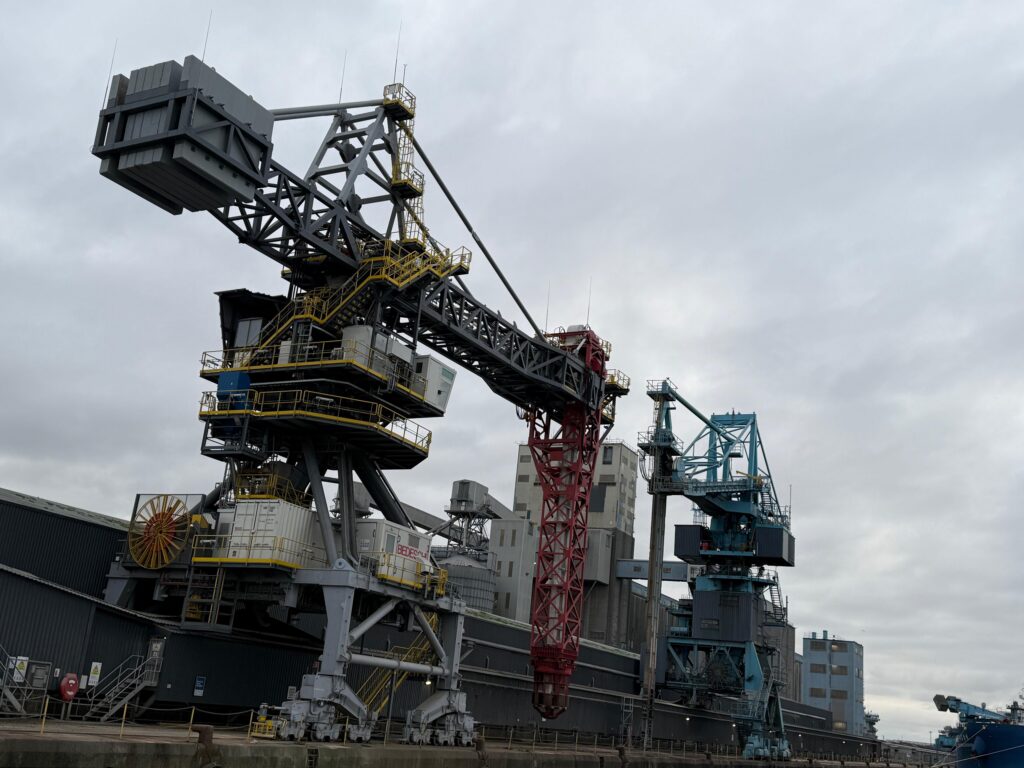
Mechanical CSU with a rated work capacity of 800 t/h for grains, oilseeds, meals and DDGS. The CSU unloads vessels with a capacity up to 80,000 DWT and has been designed to absorb 0.35 kW of power per unloaded ton.
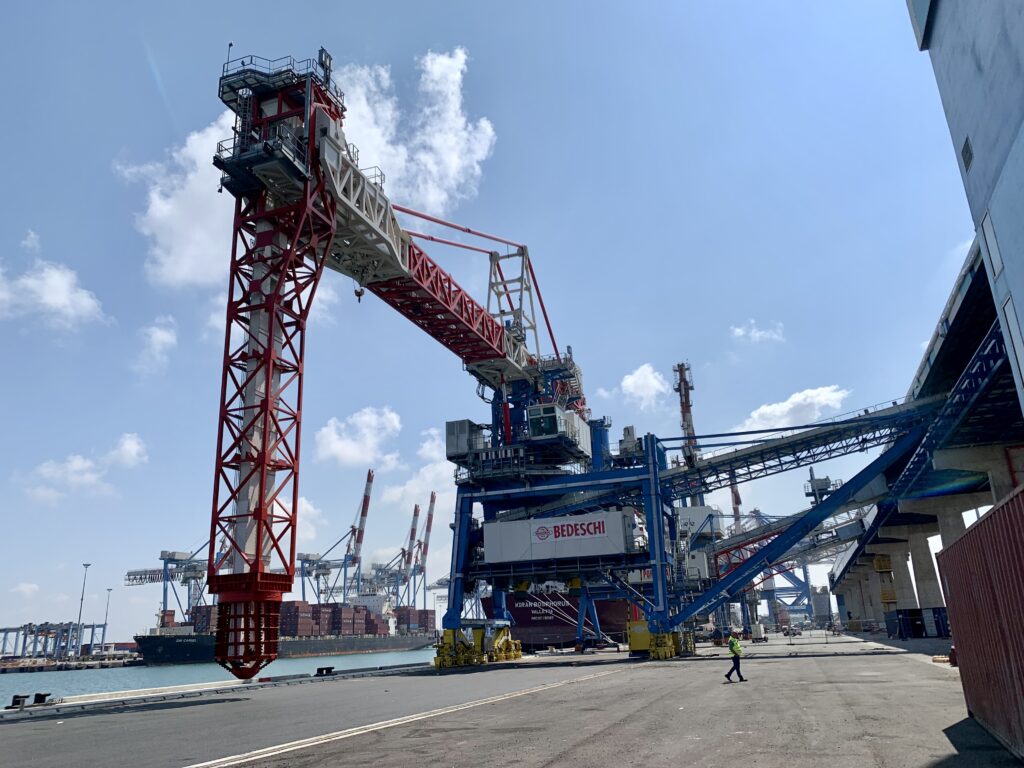
Mechanical CSU that mounts the integrated cutter for unloading both free- and non-free-flowing grains. It reaches a maximum capacity of 1,200 t/h for unloading ships up to 100,000 DWT.
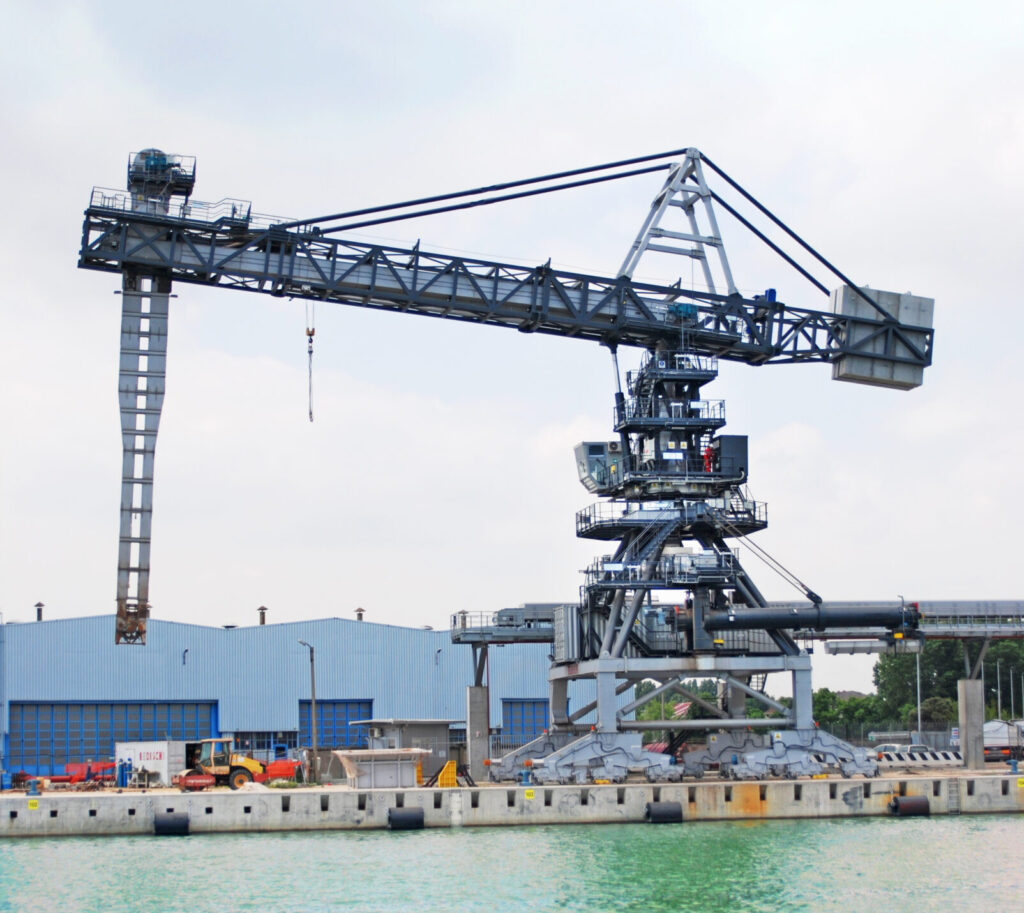
Mechanical CSU that features a rated work capacity of 800 t/h and can unloads ships up to 80,000 DWT.